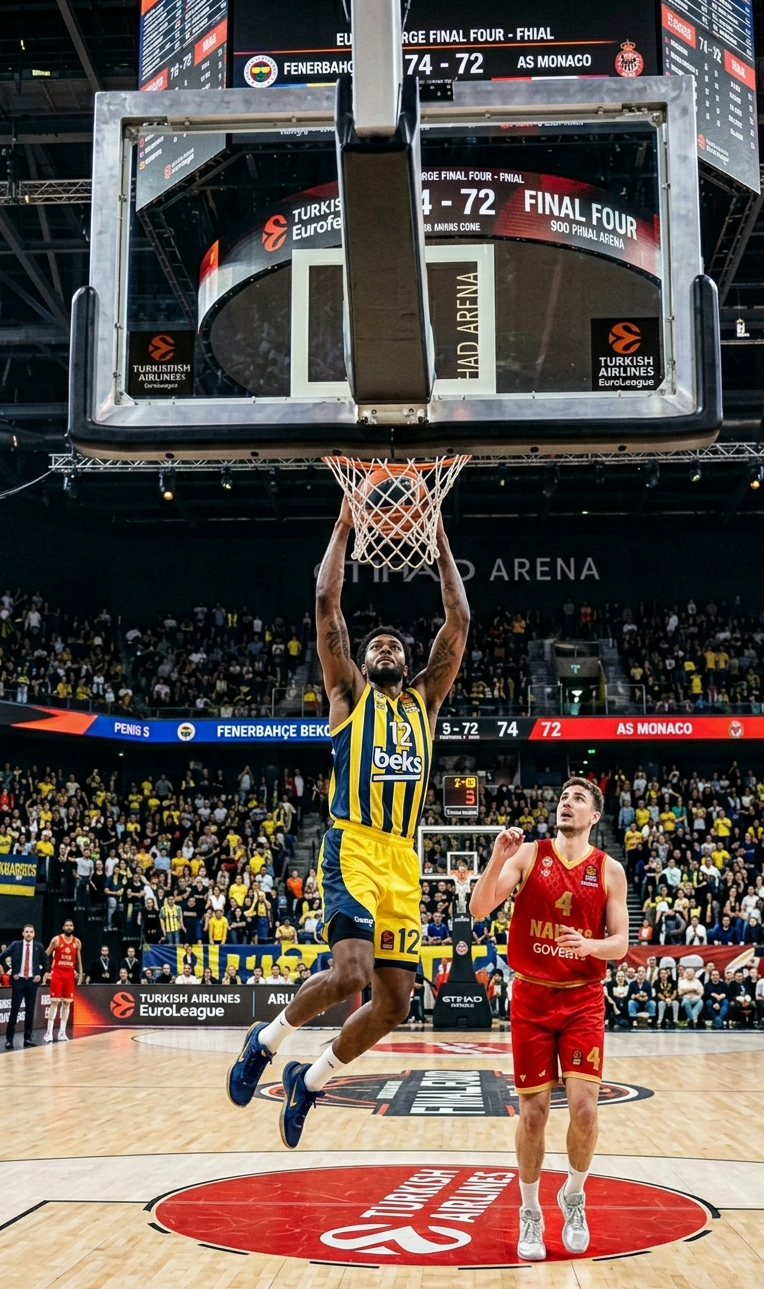
The Turkish Airlines EuroLeague Final Four is the closing weekend of European club basketball. For more than two decades the tournament had been held in European cities — Athens, Belgrade, Berlin, Madrid, Istanbul, Kaunas, Köln, Milan, Tel Aviv, Vitoria-Gasteiz. The 2025 edition broke that pattern. The Final Four moved to Etihad Arena on Yas Island, Abu Dhabi, from 23 to 25 May 2025. It was the first time in the league's history that the tournament concluded outside Europe.
For Abu Dhabi this was a significant statement. The emirate had already established itself as the regional home for NBA preseason games, with four consecutive editions of the NBA Abu Dhabi Games at the same venue. Hosting EuroLeague's closing weekend layered the European basketball calendar on top of the NBA continuity, and signalled that the UAE basketball-event positioning was now a year-round proposition rather than a single-window engagement.
IP Care delivered the IT operation for the Final Four. This case study walks through what made the engagement historic, what EuroLeague Final Four operations actually require, why the venue continuity with NBA Abu Dhabi materially shortened the build cycle, and what the engagement signals for European sports continuing to bring closing-weekend tournaments to the UAE.
— The historic context —
The EuroLeague Final Four format is a three-day closing weekend. Two semifinals on the Friday night, a rest and media day on the Saturday, the third-place game and the championship Final on the Sunday. The four participating clubs each bring their travelling staff, their broadcast crews, their commercial partners and their supporter contingents. The combined press, broadcast, sponsor and league operations footprint exceeds anything else that lands in a host arena for a three-night event.
Historically the Final Four had always returned to a European host city, partly out of competitive tradition and partly because the existing broadcast and operational infrastructure for European basketball lived in those cities. Moving the closing weekend to Abu Dhabi required the host venue to deliver on the same operational standard the EuroLeague had built up across more than twenty European editions. The technical envelope did not soften because of geography. If anything, the league watched the first overseas Final Four more closely than they would have watched any European return engagement.
For IP Care the brief was therefore familiar in shape and unfamiliar in stakes. Familiar because Etihad Arena had hosted four NBA Abu Dhabi editions and we knew the venue infrastructure deeply. Unfamiliar because the EuroLeague operations standard differs from the NBA standard in specific ways, and the league had a higher-than-usual interest in proving that a first-time overseas host could match the bar that European hosts had set.
— What EuroLeague Final Four operations actually require —
Four technical workstreams define the IT envelope for a Final Four.
The broadcast LAN. EuroLeague distributes the Final Four to a multi-territory audience across Europe, the broader Middle East, Asia and South America. Each major participating club's home market typically gets a dedicated rights-holder feed alongside the host broadcaster main feed. The broadcast LAN has to support these parallel production teams operating in the same arena with their own equipment, their own commentary, their own graphics packages and their own latency budgets back to their home production hubs.
The timing and statistics integration. EuroLeague Operations runs an integrated timing and statistics stack feeding the scoreboard, the shot clock, the game clock, the broadcast graphics, the statistical operators around the floor and the league-office data ingestion. The stack is similar in shape to the NBA timing-system integration but the specific platform, the data formats and the integration touchpoints are EuroLeague-specific. The four-team Final Four also requires the statistics integration to handle the trophy presentation, the MVP announcement and the post-game data archive into the EuroLeague historical record.
Multi-language broadcast support. The Final Four has live commentary in roughly a dozen languages across the various rights-holder feeds. The audio infrastructure has to support multiple commentary positions per match with isolated mic and translation channels, plus the international main-feed audio that gets distributed to non-rights-holder territories. The press centre carries the equivalent multi-language workload for written press.
The venue NOC and league-operations integration. EuroLeague Operations brings their own technical operations team to the host venue with a defined integration model. The venue NOC has to plug into the EuroLeague operations model the same way it plugged into the NBA operations model for the Abu Dhabi Games, with the appropriate document handover, the daily walkthroughs and the joint validation cycle through the build week.
— Why venue continuity with NBA Abu Dhabi mattered —
The 2025 EuroLeague engagement landed against a venue infrastructure that had been refined across four NBA Abu Dhabi editions. Etihad Arena's permanent WiFi 6E estate, the broadcast plant we had delivered alongside the NBA technical operations team, the timing-system cabling, the press centre LAN and the integration with venue and police command centres were all in place. The EuroLeague engagement did not require a rebuild. It required a focused intervention layered on top of existing infrastructure that already operated at international-basketball standard.
This continuity changed the build cycle materially. A first-time hosting venue for a Final Four would typically need a 6 to 9 month lead time to bring the infrastructure to league standard. Etihad Arena needed substantially less than that because most of the underlying envelope was already in place. The intervention focused on the EuroLeague-specific deltas — the statistics integration platform, the multi-language commentary positions, the additional broadcast LAN segments for the rights-holder mix the Final Four required, the league-operations integration touchpoints — rather than building the base infrastructure from scratch.
For the league this also reduced the operational risk of the first overseas Final Four. The venue was not new. The venue IT operating team was not new. The base broadcast and timing infrastructure had operated cleanly across four NBA editions. The EuroLeague-specific work landed on a foundation that had been stress-tested under comparable basketball-broadcast scrutiny several times already.
— Architecture —
The build at Etihad Arena for the Final Four layered EuroLeague-specific additions on top of the existing arena estate. Per-event additions included a dedicated EuroLeague broadcast LAN segment built around Cisco Catalyst 9500-class switches with the multicast handling and latency engineering the EuroLeague broadcast operations team specified. The EuroLeague timing and statistics integration network connected the on-floor stats positions, the scoreboard control, the shot-clock and game-clock subsystems, the broadcast graphics integration and the EuroLeague league-operations data ingestion. The multi-language commentary infrastructure carried isolated audio paths for each rights-holder commentary position. A press centre LAN scaled up for the international press contingent that travels with a Final Four. CCTV integration with venue command, ADMCC retention standards and the EuroLeague security operations centre.
Underneath the EuroLeague-specific overlay the venue's permanent infrastructure carried its standard load. HPE Aruba WiFi 6E across the bowl, concourses and hospitality. The Aruba CX 8325 switching core. The Palo Alto firewall pair. The carrier-handoff redundancy. Nothing in the base infrastructure changed for the engagement because the base infrastructure had been built to international-basketball standard already.
— Pre-event coordination —
The EuroLeague Operations team arrived in Abu Dhabi three weeks before the tournament for a series of technical walkthroughs that ran in parallel with our own pre-event validation. The walkthrough cadence was familiar from our NBA work — joint review of the broadcast LAN topology, validation of the timing-system integration against the EuroLeague reference specification, dry run of the league-office data exchange, sign-off on the press centre infrastructure, dress rehearsal of every category of in-event incident response.
A specific EuroLeague-Operations-team-led integration test ran on the Wednesday before the tournament. The test exercised the full broadcast graphics chain end-to-end with sample game data, the multi-language audio routing, the statistics ingestion to the EuroLeague league office and the trophy presentation graphics path. The test produced two findings — both minor configuration deltas on the broadcast graphics integration — which were remediated within the same working day. The EuroLeague technical operations lead signed off the integration on the Thursday morning.
— Three days of competition —
Day one (Friday 23 May). Both semifinals back-to-back. Doors at 17:00, first game at 18:00, second game at 21:00. The arena ran continuously for approximately seven hours from doors to second-game broadcast wrap. The IT operation maintained continuous monitoring across the full window. No P1 incidents during the live broadcast windows. One P3 finding on a press centre LAN switch surfaced during the post-match filing window and was remediated overnight.
Day two (Saturday 24 May). Media and practice day. Each of the four teams ran practice sessions at the venue with their travelling press contingents attending. The press centre operated continuously, the broadcast infrastructure was in maintenance and validation mode, and the IT team used the day for the overnight remediation and final dress rehearsal ahead of the Sunday games.
Day three (Sunday 25 May). Third-place game and the championship Final. The closing day carried the highest broadcast pressure of the weekend — both the third-place game and the Final attracted full international rights-holder coverage. Doors at 16:00, third-place game at 17:00, Final at 20:00. The trophy presentation followed the Final immediately. The full statistical archive and post-event broadcast wrap completed inside the planned operational window. Zero broadcast-impacting incidents across the day.
— The numbers —
Three days of competition. Approximately 17,000 spectators per game in the Etihad Arena bowl plus travelling staff, commercial partners, the four teams' supporter contingents, press, broadcast crews and league operations. International broadcast distribution across the EuroLeague rights-holder network covering Europe, the Middle East, Asia and South America. Peak concurrent device count north of 24,000 across the busiest evening once broadcast crew, press and back-of-house were factored in. Zero broadcast-impacting incidents during live game time across all three games of the weekend. Zero timing-system or statistics-feed failures.
— What worked —
Venue continuity. The four NBA Abu Dhabi editions had produced an infrastructure baseline that the EuroLeague engagement landed on top of cleanly. The lead time, the build effort and the integration risk all compressed because the foundation was already at international-basketball standard.
Team continuity. The IT team that delivered the EuroLeague Final Four was largely the team that had delivered the four NBA editions. The institutional knowledge of the venue, the broadcast plant, the timing-system cabling and the venue and police command-centre integration carried directly across. The EuroLeague Operations team encountered an IT operating partner that already knew the venue at international-basketball standard.
Treating EuroLeague Operations as a continuous engagement, not a transactional one. The three-week walkthrough cycle, the joint validation tests, the daily handshakes through the build week and the read-access for the league office into the venue NOC produced a clean integration sign-off. The pattern was the same we use for NBA technical operations integration; the specifics adapted to the EuroLeague operating model.
— What we would change for a future EuroLeague engagement —
Earlier statistics-integration validation. The EuroLeague statistics integration platform is sufficiently different from the NBA stack that even with the venue continuity advantage, the integration testing window felt tight. A future EuroLeague engagement at the same venue would benefit from a four-week pre-event statistics-integration window rather than the three-week window we ran.
Permanent multi-language commentary infrastructure. The Final Four's multi-language commentary requirement is unusual relative to the regular Etihad Arena workload. The infrastructure we deployed was scoped to the Final Four specifically and removed afterwards. For a venue that may host future multi-language broadcast events at this scale, a permanent baseline that gets re-validated rather than rebuilt would shorten future engagements.
— Why this matters for the UAE basketball calendar —
The 2025 Final Four was a milestone for the UAE in two related but distinct ways. The first is the historic significance — Europe's premier club basketball tournament concluded outside Europe for the first time, and the host emirate delivered the operating standard the league required. That is a legacy moment for the UAE sports calendar.
The second is the practical implication. With NBA Abu Dhabi running for four consecutive editions and EuroLeague's closing weekend now in the host portfolio, the UAE has positioned itself as a year-round international basketball venue rather than a single-tournament host. The infrastructure, the operating team and the league relationships that make that positioning credible are now in place at Etihad Arena and across the broader Abu Dhabi event ecosystem.
For European leagues considering future overseas closing-weekend tournaments, the 2025 EuroLeague Final Four sets a working precedent. The historic-first label is permanent. The operational template for delivering at this level outside Europe is now documented through a successful tournament. Both legacies are real.
— Bottom line —
A historic first-overseas Final Four delivered against the same operational standard the EuroLeague applies to European hosts. The venue continuity advantage from the four NBA Abu Dhabi editions materially shortened the build cycle. The IT team that delivered the Final Four was the same team that had refined the venue across the NBA engagements. The integration with EuroLeague Operations carried the same continuous-engagement discipline we apply to NBA technical operations.
For the EuroLeague the Abu Dhabi Final Four demonstrated that the closing weekend operating standard travels. For the UAE it demonstrated that the basketball-host positioning the emirate has built across multiple NBA editions extends cleanly to European basketball at the highest competitive level. For IP Care it was the most operationally satisfying league-standards engagement of the year — a historic first delivered cleanly against a familiar venue with a familiar team.